Thank you! Your submission has been received!
Oops! Something went wrong while submitting the form.
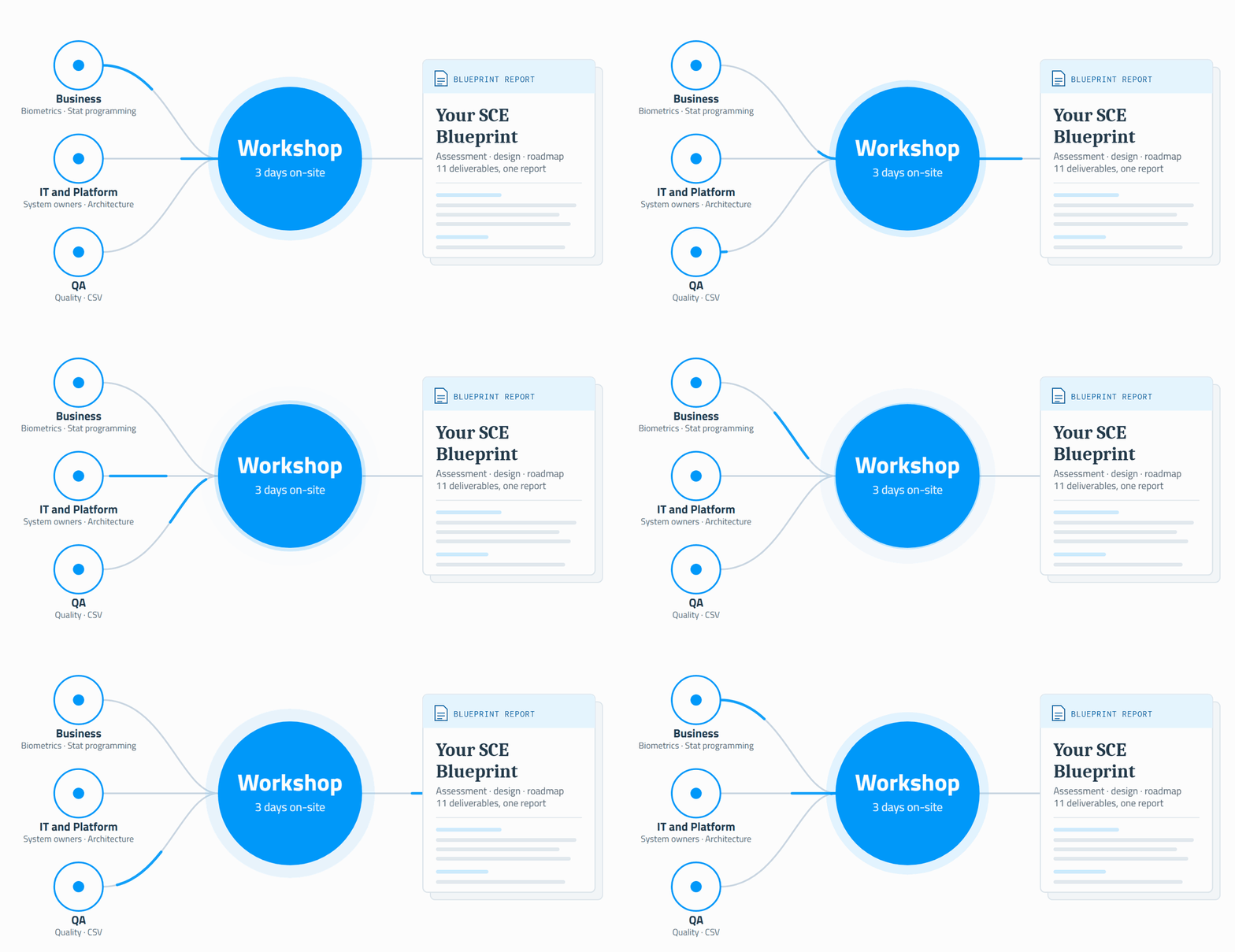
Three days on-site with our senior SCE architects, your QA in the room. You leave with one report: where you stand, what to build in what order, what it costs, and what QA will accept.
What is missing is rarely engineering capacity. It is a written picture of what your statistical computing environment has to do, which of the systems you already run can supply part of it, and what QA will require to release it. Three patterns come up in almost every conversation we have.
Engineering writes the requirements, QA reviews them afterward, and the design is reworked when compliance requirements surface. The rework is paid at implementation rates.
Two or three proofs of concept run in parallel on the repository layer, with no agreed criterion for choosing and no view of which option shortens or lengthens qualification.
Without defined requirements, a concrete use case, and a proposed technical solution, QA cannot say how long qualification will take. The management date does not move.
The workshop produces a written report your team builds from. It assesses what you have today against what your SCE has to do, recommends the target design, settles the storage question, and sequences the build so the first increment can be funded and qualified on its own. The validation strategy is one part of it, not the whole.
D1 Current-state process map · D3 Gap analysis across technology, process, and ownership, including which existing systems can close part of it
D2 Target-state design, with reusable components from systems you already run · D7 Regulatory review against Part 11, Annex 11, GAMP 5, ALCOA++ · D8 GxP / non-GxP boundary
D4 Storage assessment: your own lakeFS, Databricks, or S3 evaluation held against what the design demands, with a recommendation you can defend
D5 Roadmap, increment one scoped and estimated · D6 Decision record for your approval board · D9 Incremental qualification assessment, with QA · D10 Validation and qualification strategy · D11 Requirements set for increment one
Focused preparation before, structured write-up after. Business, IT and platform, statistical programming, data management, QA, and the people who can commit to scope work side by side for all three days.
Your catalogues, systems list, and documentation. The compliance track reviews your SOPs and runs a 21 CFR Part 11 readiness assessment.
Your as-is process captured as an audit-ready map, for context only. QA is in the room from the first hour.
Designed in one working session. Every requirement is tagged for compliance relevance as it is captured, so QA reviews a design it helped shape. Your SCE requirements are captured here too, along with an assessment of which systems you already run could supply reusable components.
Your storage direction held against the design. Risk-based validation strategy, the roadmap that funds increment one, and management sign-off.
Gap analysis, storage assessment, validation strategy, roadmap, and decision record. We stay available for questions.
#Who Runs It
Designs the target state with your team and challenges the assumptions under it, including ours.
Knows what production runs, study promotion, and job orchestration cost on the stack you have.
Part 11, Annex 11, and GAMP 5. Writes a validation strategy your QA can sign.
Three days on-site with travel, plus embedded compliance track. No prep fees. Typical timeline: 1 month for contracting + prep, on-site the following month, deliverables 2 weeks after.
You leave with a costed first increment. What happens next is your call: build it with your own engineers, put parts of it out to tender, or bring us in — fractionally for the parts that stall, or for the full SCE build.
Book a Scoping CallA management date for a qualified environment, or a submission within 24 months
Legacy execution or repository tools being phased out
Storage proofs of concept running in parallel with no decision
A newly hired internal engineering team that needs direction
A QA function that cannot estimate qualification without defined requirements
Not a fit: a near-term fix for your current environment, a SAS-to-R migration programme, or a storage bake-off. Discovery produces a design and a plan, not an implementation.
#After the Workshop
Discovery ends with a plan and a costed first increment. Most teams build from there with their own engineers and call us for the parts that stall — Posit internals, job submission and automation, lineage instrumentation.
A senior architect reviewing your team's decisions as they make them, on a fractional basis.
Turning engineering work into artefacts QA accepts, in the structure they expect. This is where internal builds stall, not on the engineering.
Evidence, protocols, and documentation for each release, so qualification does not become the bottleneck.
Data Engineering Lead
Top 10 Pharma Company








Ebook for Clinical Data & Platform Leaders
What a modern SCE has to include, how risk-based validation works in practice, where AI fits inside the compliance boundary, and how other pharma teams sequenced their builds.


What clients ask before booking. Anything else, ask on the call.
You have a date for a GxP-qualified statistical computing environment. Your team can build it. What nobody has written down is what it must do, which of your existing systems you can reuse, what the storage layer should be, and what QA will need to qualify each release. Three days on-site settles that. You leave with one report: a gap analysis against your current state, the target design reviewed against 21 CFR Part 11, EU Annex 11, GAMP 5 and ALCOA++, a storage recommendation, a validation and qualification strategy your QA helped write, a requirements set for increment one, and a roadmap with that increment scoped, estimated, and backed by a decision record for your approval board.
Yes. A named QA counterpart with authority to approve the validation approach, engaged from week one. QA does not need to attend every technical session, but must be present for the process narrative on Day 1, the requirements capture on Day 2, and the validation strategy on Day 3.
No. Discovery produces a design and a plan: no configuration, no infrastructure code, no IQ/OQ/PQ execution. Implementation is scoped separately from the roadmap and the increment-one estimate. If you want us to build it, that is our SCE implementation service. Taking the report to your own team, or to another vendor, is just as normal an outcome.
Your data catalogue, persona catalogue, systems and infrastructure list, existing documentation, the SOPs governing study promotion, validation reporting, and change control, and your storage evaluation material. We send a pre-read list at contracting.
The three days are designed as one on-site block, because the value comes from business, technical, and QA people deciding together. Individual participants can join remotely where needed.
Yes. The compliance track is part of the fixed price. Additional sessions you request are scoped and quoted case by case.
From custom dashboards and applications to AI-powered solutions and compliant computing environments, our engineers and infrastructure architects accelerate clinical development within fully validated, regulatory-compliant frameworks.