Thank you! Your submission has been received!
Oops! Something went wrong while submitting the form.
We assess the Shiny app your teams already use, show you where it stands against GxP requirements, and hand you a costed roadmap to close the gap. Delivered alongside your developers and your QA, not around them.

Teams rarely stall because the app is bad. They stall because nobody in the room can answer the same questions: what exactly are we validating, how will we know when we are done, and what happens at the next release?
Nobody can say what "done" looks like. QA asks what is being tested and when there is enough, and four thousand lines of reactive code offer no answer.
QA arrives after the design is locked. Requirements get reviewed late and reworked at implementation rates, and the week-long review cycle repeats on every iteration.
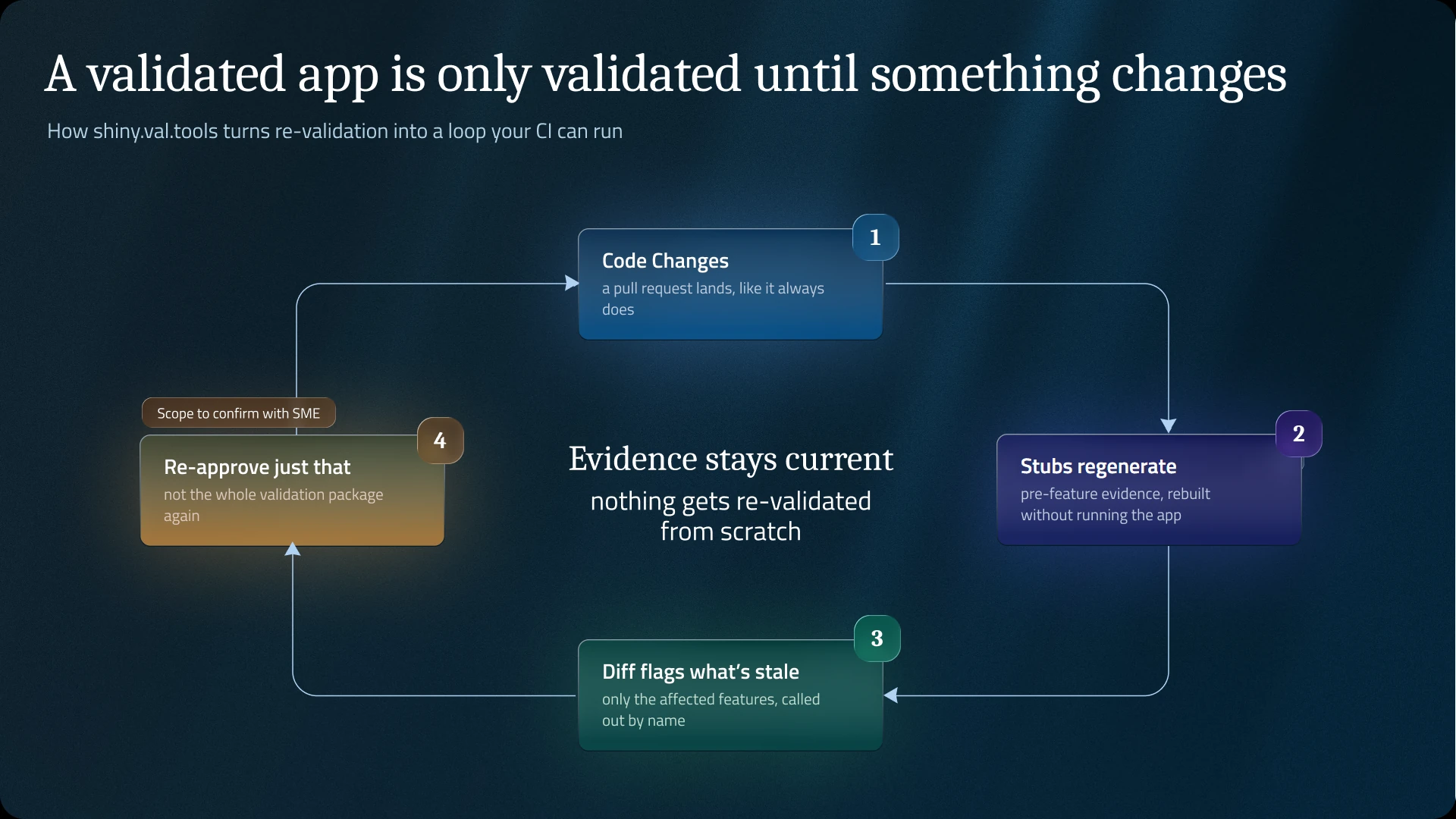
The app is validated until something changes. Validated as one unit, a single label change re-opens the whole packet, test run, and signature loop.
Nobody can name the validated surface. Behaviour no feature claims is unsupported by construction, and most teams cannot say where that line sits.
A package arrives with its own unit of validation: exported functions, documentation, a test suite, a version number. An app has none of that. It is a reactive graph with no natural seam to cut along, so teams fall back on validating the whole app as one blob, or validating the package list. We work from a different unit. A feature is the closed reactive subgraph rooted at an output.
Read the full method: Validating Your First Shiny App for GxP, a Survival GuidePick something a user can see: a Kaplan-Meier plot, an adverse events table, an export button. Then collect everything upstream that has to be right for it to be right. The set is bounded, so you can enumerate it.
Nobody writes an intended-use statement about a reactive expression. They write one about the curve for the primary endpoint, and the subgraph is scoped to exactly that.
A module's validation surface is its contract: the inputs it owns, the outputs it owns, and what it returns. Validate it on its own and every feature that instantiates it inherits that result.
Edit a module and only that module and the features consuming it come back into scope. The rest of the app stays where it is, which is what ends the habit of batching changes for months.
The union of your declared features is what is validated. Behaviour a user can reach that no feature claims is unsupported by construction, and an auditor can ask you which is which.
Behaviour no feature claims is a validation gap. A claimed feature no test exercises is a verification gap. An app at zero on both is fully claimed and fully exercised, and that fits on one line.
shiny.val.tools reads your app's R source and works out what depends on what. It writes the artifacts a GxP audit expects: a per-feature reactive subgraph, the packages and functions each feature actually calls, test scaffolding, a traceability matrix, and a signable validation report. It does not run your app, and it does not run your tests. It produces evidence for someone else to validate, and the conclusion and approval sections are left for a person and preserved verbatim from then on.
shiny.val.tools is open source. Point it at your app and it will produce the per-feature subgraphs, the function inventory, and a first traceability matrix before you ever talk to us.
See the RepoYour timeline depends on the app, the state of your environment, and your internal approval cycles. A QA review cycle alone runs about a week, which is why we bring QA in from the first week and run delivery as a milestone-based rollout with clear checkpoints.
We agree which app, which modules are in scope, and what your QA group needs to see. Access and environment approvals start here, because in regulated organizations they are usually the real bottleneck.
Current-state review of architecture, modules, technical debt, data flow and transformation logic. Gap analysis split by what sits at app level and what sits at platform level, a package and function inventory, and an effort estimate broken down per module so you can sequence and fund it.
Test strategy and coverage where it matters, with regression protection for package and environment changes. A development process your QA can approve. Architecture work where structure is the blocker, and validation evidence produced from the code.
As the app changes, the evidence is re-run and the diff shows which parts have gone stale. Only the changed module and the features consuming it come back into scope, so a release stops meaning a full re-validation.








Data Engineering Lead
Top 10 Pharma Company
Associate Director
Top 50 Pharma Company
Human Resources People Partner
Top 10 Pharma Company
A trusted partner to leading pharmaceutical and life sciences organizations worldwide.
Out of 15,000+ applicants each year, only 1% are selected to join our team - a diverse group of programmers, managers, biostatisticians, and PhD-level scientists actively contributing to the industry.
With over 150 projects delivered for pharmaceutical companies, you gain access to our deep, collective expertise and training support from experienced delivery managers, biostatisticians, programmers, and scientists.
Our team members are creators and contributors to open-source frameworks such as Rhino, aNCA, teal, and many more—collectively downloaded nearly 500,000 times. We are active participants in Pharmaverse and R Consortium working groups.
8 out of the 10 world’s largest pharmaceutical companies have trusted our programmers and statisticians to support AI-driven workflows, analyse all types from data: from clinical and real-world data (RWD) to drug discovery experiments.
Common questions about validating a Shiny app for regulated use, and where the line sits between what we produce and what your QA group signs.
No. Validation is your QA group's to own and sign. We assess the app, close the engineering gaps, and produce evidence in a form your QA can accept. The same line applies to our tooling: shiny.val.tools produces validation evidence, it does not validate your app.
They are adjacent layers of one stack. Package validation answers whether a package is safe to use. This answers which functions a given feature actually calls, and what the validated surface of your app is. Most regulated teams need both.
Yes. App validation and platform qualification are separate but interdependent tracks, and they can run in parallel. Phase 1 tells you which requirements sit at app level and which sit at platform level, so neither team waits on the other unnecessarily.
No, and it is the common starting point. The assessment shows concretely how much each feature drags in, which is usually a clearer argument for restructuring than anything said in a meeting. The method rewards refactoring, and it is honest about what it cannot give you until then.
No. shiny.val.tools is open source and optional. The method works without it, and the tool removes the manual effort of producing the artifacts. You can run it against your app before you contact us.
Re-run, and the diff shows which evidence has gone stale. Only the changed module and the features consuming it come back into scope, so a label change no longer re-opens the whole packet, the whole test run, and the whole signature loop.
From custom dashboards and applications to AI-powered solutions and compliant computing environments, our engineers and infrastructure architects accelerate clinical development within fully validated, regulatory-compliant frameworks.


